Hiển thị các bài đăng có nhãn Watercolor Painting. Hiển thị tất cả bài đăng

Thứ Năm, 5 tháng 11, 2009

Sketching the Mechanical Elephant

Here's a colored pencil sketch of the Sultan's Elephant, drawn a few days ago from observation in Nantes, France. (Click on the image for a big enlargement.)

I took a picture (left) after starting the sketch to show you one way to begin a small drawing like this (about 3x5 inches). The first step was to draw the basic outlines in graphite pencil.

Then I lightly rubbed the surface with a few browns and grays in water-soluble colored pencil. Since there was no delicate detail yet, I could smudge those colors around with a water brush, keeping the white highlights on the tusk and the forehead as untouched white paper.

After that dried, I went back to define the details with a black colored pencil. The whole sketch took about 45 minutes, and I had to finish because the thing started walking.

Thứ Ba, 3 tháng 11, 2009

Backlit Parked Car

Here's a quick impression in a mini-Moleskine watercolor sketchbook. What interested me was the ordinariness of a parked car alongside a canal. Because I was looking toward the hazy source of illumination, the challenge was to save out the little bits of rim lighting as I did my first overall wash over the dry paper surface.

In a contre-jour situation, it helps to keep those light bits crisp, and then let the shadowed areas——such as the areas around the wheels and the base of the car——relatively soft and out-of-focus.

If you like Moleskines, check out the creative showcase blog Moleskinerie.

Thứ Năm, 29 tháng 10, 2009

Jules Verne Museum

The Utopiales festival here in Nantes is wonderful--more details soon on the amazing people and artwork we have seen, but first a few little side excursions.

We arrived before the event began, so had time to do a little sketching. I've been intrigued with this idea of doing fantasy sketches on location, with the subject in front of you for inspiration.

What struck me about the exterior of the Jules Verne Museum, right, was the way it the historic building sits on the brow of a steep cliff, with a statue of St. Anne atop a long flight of stairs.

So I painted this 7 x 9-inch sketch on location, trying to imagine it separated from gravity on its own journey to another world.

I'm working on a separate piece of hot press watercolor paper, using fairly traditional watercolor. After laying in th broad masses of the sky, rock, and architecture, I further defined the details and textures using water-soluble colored pencils. This is a fairly fast way of working; the whole painting was finished on location in two and a half hours, but it would have taken me far longer to do the same thing in the studio.
-----
Article on Presse Océan, link.

Thứ Bảy, 13 tháng 6, 2009

Csont and New Urbanism

David Csont is one of the most admired members of the American Society of Architectural Illustrators (ASAI). He’s a principal of the firm Urban Design Associates in Pittsburgh, which is a leader in New Urbanism. New Urbanism is a movement to design communities to be more walkable, diverse, and sustainable.


Mr. Csont spends a lot of time meeting with his clients all over the world. He brings his watercolor setup to those meetings and paints right there at the conference table. Seeing his colorful renderings take shape before their eyes energizes planning groups and gets them thinking about specifics.

Although his firm uses computers extensively, this role of visualizing with traditional media can’t be replaced by the machine because of the artist’s ability to select and accentuate detail and to convey mood. Below: overviews produced by his team.

For Mr. Csont, the appeal of new urbanism grows out of childhood experiences of intact traditional communities. “I grew up in a suburban neighborhood,” Mr. Csont told me. “My grandmother lived in an old house in a traditional neighborhood. We’d sit on the front porch and watch the cars go by. There was a store on the corner and she would send me out for a loaf of bread. Those were my fondest memories.”
--------
New Urbanism on Wikipedia and Official Site
Urban Design Associates website
Dave Csont Bio
American Society of Architectural Illustrators (ASAI) website

Thứ Ba, 3 tháng 3, 2009

Beaux-Arts Architecture

Architecture students at the École des Beaux-Arts in Paris studied the proportions and the ornament of Greek and Roman buildings, and they became masters at rendering them in ink and watercolor.

The winners of of the Prix de Rome competition were sent to Rome at government expense to do extensive studies of famous monuments. They periodically sent back drawings showing ornamental details, reconstructed facades, or perspective scenes of famous vistas, like the Forum or the Acropolis.


Artists adhered to particular conventions for representing architectural forms. The light had to come from the left at a 45-degree angle. Values lightened systematically as they went back in space. (Above: Constant Moyaux, Below: Normand, 1852)

Students developed concepts in relatively loose sketches. Then they began the presentation drawings in line, usually in grayed-down India ink, with a series of very light washes of tone to build up the modeling gradually so that the tones seemed to reside in the paper rather than being superimposed over it.
------------
There’s an affordable book from Dover that reprints in black and white a famous set of prints assembled by Hector d’Espouy, link.
Wikipedia on Beaux-Arts Architecture, link.

Thứ Hai, 2 tháng 2, 2009

Synthetic Flats

Synthetic-filament brushes come in a variety of shapes: flats, filberts, and rounds. Flats are especially useful for painting architecture and machines because they can lay down rectangular shapes easily. You can also turn them sideways to paint a fine line.


Here I'm using a Winsor and Newton Series 995 Golden Taklon ½ inch flat to establish the dark shape of a crypt door.

The finished watercolor painting shows the chunky half-inch stroke module in the stonework and the big shadows. I also used a #4 sable round travel brush for some of the fine line work.

You can use ¼ inch nylon flats with oil or acrylic. For opaque media they come with longer handles. They’re inexpensive, but they don’t last long. Eventually lose their chisel-sharp edge.

Thứ Bảy, 24 tháng 1, 2009

Moleskine Loves Schmincke

Did you know that a Schmincke watercolor set opens up to the same size as a Moleskine watercolor book?


That means you can set up the paint kit on the facing page, next to where you need it.


You can clamp it to your Moley with a spring clip. The water cup is taped to the Schmicke so it doesn’t tip over and dump all over your work. Wrap some extra tape around your water cup, because tape always comes in handy.


With the rag in one hand and the brush in the other, you’ve got everything you need within reach. It will serve you if you’re leaning on a paddock rail, crowded into in an Irish pub, or perched a mountaintop.


Here’s the painting of Gibraltar next to the real thing.
--------
Previous GJ post on light sketching supplies: link.

Thứ Hai, 19 tháng 1, 2009

The Cliché and the Surprise

I know, I know. A lighthouse is a tiresome cliché. Haven’t we seen a thousand paintings of lighthouses just like this one? It’s like other well-worn motifs——the barn or the fishing boat. It can be hard to find a twist or a connection to make it interesting.


But I was tired from walking for four miles along Gibraltar, and I just plunked down and painted it from the first angle I saw it from. There was nothing interesting or unusual about the painting. I was just thinking as I painted the lighthouse how the brave lighthouse keeper had protected ships from the dangers of the coast.


Imagine my surprise when I finished the painting, packed up my stuff and walked a hundred yards farther. Hidden behind the level of the bluff was a jaw-dropping shipwreck. In the foreground was a junkyard of refrigerators inhabited by wild monkeys. Motifs everywhere! But I had to go catch a plane.

I guess the lesson is to take a minute to walk once around the motif before you get started.

Thứ Bảy, 10 tháng 1, 2009

Mr. Moha of Aït Benhaddou

Beyond the Grand Atlas Mountains of Morocco, the kasbahs are made from a reddish brown mudbrick, what we would call adobe in North America.


In the fortified city of Aït Benhaddou, I met Assofi Moha, a Berber man who sold leather and brass handicrafts to the occasional tourist.


He sat on a short stool in the sunny alley. I sat across from him, and when he saw me sitting on the ground, he took the little cushion off his own stool and offered it to me. We got talking and he agreed to pose for a quick watercolor portrait. The bright sun cast dark shadows from his features.


When the portrait was finished, I handed him a fountain pen, and he wrote his name.

Thứ Sáu, 2 tháng 1, 2009

The Coppersmith

Merchants in the inner markets of Fes, Morocco get their supplies by donkey, not by truck or motorcycle. The donkeys jostled against me, nearly knocking me over. The smell of the spice and perfume filled the air. Veiled women shyly hid their faces.


After an hour of walking through the labryrinth I came to Seffarine Square. Tiny shopfronts crowded the small opening. A coppersmith named Hamid Aziz hammered a pot.


I sat in the middle of the square on an orange crate and began a watercolor. But I forgot to bring water! Hamid poured some for me into a chipped glass from a silver teapot that he kept beside him.


A few bewildered tourists stopped to watch, but most of the commentary behind me was in Arabic. When I finished the sketch, I showed it to Hamid and his friends.

Thứ Bảy, 27 tháng 12, 2008

Rain and Watercolor

Rain is the death of watercolor. I knew I was in trouble when the clouds rolled in over the Crateri Silvestri in Sicily last month.


These cinder cones are high on the summit of Etna. I walked around their rims and gazed in, but the clouds closed in.


By the time I started a sketch, a steady drizzle started. The washes in the sky wouldn't dry. I leaned forward to intercept the drops. But you can see from the droplets in the sky that I couldn't block them. I just had to admit defeat and head down the mountain.

Thứ Bảy, 20 tháng 12, 2008

Gate into Fes, Morocco

The gate into Fes, Morocco, known as Bab Boujeloud, was covered in scaffolding when I sat down to sketch the scene from a nearby café. The first thing I did was delete the construction clutter. The busy tilework would give me enough of a headache.


Created with Admarket's flickrSLiDR.

Donkeys ducked into the arch, carrying loads of of animal hides bound for the tanneries. Red taxis disgorged tourists, but no cars ventured past the portal. Beyond the gate is one of the largest medieval pedestrian cities in the world.


The ornate blue tile work was too finicky to paint with a brush, so I scribbled a suggestion of the detail with a blue colored pencil. I’m no purist in watercolor. I mix in pencils or gouache or coffee stains whenever they serve to capture the something about the scene that doesn’t yield to traditional means.

Thứ Năm, 18 tháng 12, 2008

Port of Tangier

The old city or medina of Tangier, Morocco looks like white crystals growing on the northernmost hill of the city, overlooking the modern port facility.

The ferry terminal building looks like a space station in the foreground of the scene. The view is from the rear deck of the ferry. Since the ferry took a long time to load, I had lots of time to do a watercolor painting.


Here's a pan across the scene and down to the sketchbook in my lap, with the sound of the public address system.


All those white mullions in the windows were a bit of a chore to paint around. You can see me fumbling around with the sable round. It would have been bettter to have a small chisel tipped flat brush for those square shapes.

Chủ Nhật, 14 tháng 12, 2008

Rabat Alley

In this quick watercolor painting of a narrow street in Rabat, Malta, the goal was to keep the shadow together as one shape. The edge of the shadow is cool on the upper right, where it picks up the color of the sky.

And the shaded buildings on the left are warm where they receive reflected light from the warm illuminated buildings.

But compared to the light tones in the distance, the shadow is one basic tone, and I tried to downplay the detail in the doorways and windows in the shadow area to keep it simple.


Here's how the little street appeared as I painted it, with bells ringing and car driving into it.

Thứ Năm, 11 tháng 12, 2008

Watercolor Portrait, Tangier


A couple weeks ago I posted this watercolor portrait of Zack, the antique dealer. He posed for me at a cafe in the old medina of Tangier, Morocco.

Here's a new video to show you the atmosphere of the scene. The light was coming from the blue sky above the square where we were sitting, and it made a cool highlight on the top of his head. Film by Alan Dean Foster.

Geneva Church

Here’s a small sketch with watercolor pencils of a church in Geneva. I left out a lot of detail, mainly because of a lack of time, and I gradated the tones of the tower to a light tone behind the two figures.

Thứ Ba, 9 tháng 12, 2008

Trost Richards Watercolor

Blog reader (1833-1905) Daroo asked to see more gouache paintings by William Trost Richards. This 9x14 inch gem, called Lake Squam from Red Hill (1874) is from the Metropolitan Museum's collection, link.

Trost Richards combined the luminous grandeur of Turner with an American PreRaphaelite sense of carefully observed detail. He often worked semi-opaque watercolor over a gray-green tone paper.

Here's a plein air seascape that captures the full range of big waves, ripples, foam, and recoil. WTR is best known for his seascapes and his Adirondack mountainscapes.

You can see a variety of WTR works for sale at William Varieka Fine Arts, link.
Another good website is "William Trost Richards, The Complete Works," link.

Thứ Hai, 8 tháng 12, 2008

Minaret in Tunis

I try not to get nervous when a soldier with a machine gun watches me paint. But this guy in the medina of Tunis was very cool. There was a language barrier, so after I exhausted my pleasantries in French and Arabic, he just quietly watched.

I actually spent two sessions to capture this watercolor of the minaret at the Sidi Youssef mosque in Tunis. The sun was rapidly setting and the moon rising, while the light of the souq was brightening. I used gouache on this one just for the sky, because I couldn't capture the even gradation in transparent watercolor.

Here's the narrow street where I was painting (photo courtesy Alan Dean Foster). The loudspeakers from the minaret resounded with the call to prayer, and behind me in the government square, a brass band accompanied the daily flag ceremony.

Thứ Bảy, 6 tháng 12, 2008

Styles of Perception

What is the visual world composed of? When we look around us, what do we see? Do we see lines or tones? Do we see discreet objects with definite boundaries or a hodgepodge of indistinct splotches merging and melting into one other?
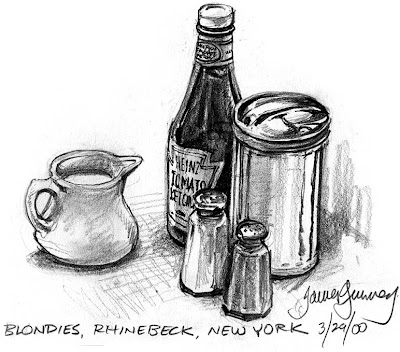
How you answer these questions lays at the heart of how you approach a drawing.

The first drawing interprets the classic diner still life as separate, rational objects bounded by clear outlines. The salt and pepper shakers appear as distinct shapes that could be cut out from the background.

The second drawing is a bit more subjective. The pepper shaker on the right melts into the background a little more, and tones of shadows blend the bases of the objects into the table surface.

The third drawing, made with a brush and watercolor, interprets the world not as a series of definite objects but rather as spots or shapes that come together to suggest forms. The creamer at the lower left almost disappears into its surroundings; we see only a hint of its handle.

This is not merely a matter of style or technique. One approach is not better than another. There’s no right or wrong way to see the world and no right or wrong way to draw it. Different people actually see things differently.

In fact, new research in visual perception suggests that the human retina is not like a camera, but more like a kind of a pre-brain. Some groups of retinal receptors bundle visual information into packets describing linear boundaries. Other receptors bundle information about tonal shapes. These packets are then processed downstream in the visual cortex. The retina transmits data at a rate of 10 million bits per second, which is about equivalent to an Ethernet connection. (link)

The way you see is probably not the way I see, regardless of our training or tradition. The way your retina apportions its visual processing tasks is as unique as your fingerprint. You may see things more in terms of line and I may see things more in terms of tone.

The way our eyes apprehend the world is infinitely mysterious. As artists we need to yank ourselves out of our comfortable habits of perception. We need to grow beyond the easy tricks that worked for us in the past. We need to strive always to see with new eyes.

Thứ Năm, 4 tháng 12, 2008

Sousse Harbor

Here is a watercolor painting of some small fishing boats in the harbor of Sousse, Tunisia. What attracted me was the bright light coming from behind, which made the gunwales white.

I also liked the foreground boats: one with a yellow tarp over the hold, and the other blue one in the extreme foreground.The bright sunspot at the center of the picture was so strong that it bleached out the dark tones of the the gunwale of the dinghy at center.


You can see the bleaching effect of the bright sunspot in this little video as I pan across the dinghy. The video makes another point: nothing holds still for the plein air painter! Just as I was halfway finished with the picture, the old man started up the boat in the foreground and pushed aside all of the others.


Here's one last video capturing the moment when I was painting the yellow tarp. This is very low-tech video, and something of an experiment. I'm just using a Canon Powershot 400 held in my left hand. It's kind of hard to concentrate on everything at once, and I was afraid of dropping the camera into the water.