Main website for Sinterklaas.
Chủ Nhật, 7 tháng 12, 2008
Sinterklaas Festival in Rhinebeck
Main website for Sinterklaas.
Thứ Bảy, 6 tháng 12, 2008
Styles of Perception
What is the visual world composed of? When we look around us, what do we see? Do we see lines or tones? Do we see discreet objects with definite boundaries or a hodgepodge of indistinct splotches merging and melting into one other?
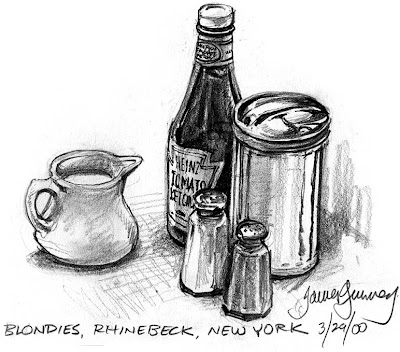
How you answer these questions lays at the heart of how you approach a drawing.
The first drawing interprets the classic diner still life as separate, rational objects bounded by clear outlines. The salt and pepper shakers appear as distinct shapes that could be cut out from the background.
The second drawing is a bit more subjective. The pepper shaker on the right melts into the background a little more, and tones of shadows blend the bases of the objects into the table surface.
The third drawing, made with a brush and watercolor, interprets the world not as a series of definite objects but rather as spots or shapes that come together to suggest forms. The creamer at the lower left almost disappears into its surroundings; we see only a hint of its handle.
This is not merely a matter of style or technique. One approach is not better than another. There’s no right or wrong way to see the world and no right or wrong way to draw it. Different people actually see things differently.
In fact, new research in visual perception suggests that the human retina is not like a camera, but more like a kind of a pre-brain. Some groups of retinal receptors bundle visual information into packets describing linear boundaries. Other receptors bundle information about tonal shapes. These packets are then processed downstream in the visual cortex. The retina transmits data at a rate of 10 million bits per second, which is about equivalent to an Ethernet connection. (link)
The way you see is probably not the way I see, regardless of our training or tradition. The way your retina apportions its visual processing tasks is as unique as your fingerprint. You may see things more in terms of line and I may see things more in terms of tone.
The way our eyes apprehend the world is infinitely mysterious. As artists we need to yank ourselves out of our comfortable habits of perception. We need to grow beyond the easy tricks that worked for us in the past. We need to strive always to see with new eyes.
How you answer these questions lays at the heart of how you approach a drawing.The first drawing interprets the classic diner still life as separate, rational objects bounded by clear outlines. The salt and pepper shakers appear as distinct shapes that could be cut out from the background.
The second drawing is a bit more subjective. The pepper shaker on the right melts into the background a little more, and tones of shadows blend the bases of the objects into the table surface.The third drawing, made with a brush and watercolor, interprets the world not as a series of definite objects but rather as spots or shapes that come together to suggest forms. The creamer at the lower left almost disappears into its surroundings; we see only a hint of its handle.
This is not merely a matter of style or technique. One approach is not better than another. There’s no right or wrong way to see the world and no right or wrong way to draw it. Different people actually see things differently.In fact, new research in visual perception suggests that the human retina is not like a camera, but more like a kind of a pre-brain. Some groups of retinal receptors bundle visual information into packets describing linear boundaries. Other receptors bundle information about tonal shapes. These packets are then processed downstream in the visual cortex. The retina transmits data at a rate of 10 million bits per second, which is about equivalent to an Ethernet connection. (link)
The way you see is probably not the way I see, regardless of our training or tradition. The way your retina apportions its visual processing tasks is as unique as your fingerprint. You may see things more in terms of line and I may see things more in terms of tone.
The way our eyes apprehend the world is infinitely mysterious. As artists we need to yank ourselves out of our comfortable habits of perception. We need to grow beyond the easy tricks that worked for us in the past. We need to strive always to see with new eyes.
Thứ Sáu, 5 tháng 12, 2008
TV Spot Storyboard
In CG- or cel-animated films, every shot is planned in small sketches. Most effects-heavy live action films are also extensively boarded. The storyboards not only help plan the cinematic art, but they also serve as the director’s map for how all the separate elements will fit together.
Many films now use digitally animated storyboards or cinematics to allow the director and the effects supervisor to give a semblance of how the parts of the scene will move.
I did these storyboards in 1992 for a contemplated TV ad spot for the Dinotopia book. The ad was never produced. The idea of a skeleton rising from the earth is based on the classic story from Ezekiel of the dry bones lifting up and coming to life.
Many films now use digitally animated storyboards or cinematics to allow the director and the effects supervisor to give a semblance of how the parts of the scene will move.
Thứ Năm, 4 tháng 12, 2008
Sousse Harbor
Here is a watercolor painting of some small fishing boats in the harbor of Sousse, Tunisia. What attracted me was the bright light coming from behind, which made the gunwales white.
I also liked the foreground boats: one with a yellow tarp over the hold, and the other blue one in the extreme foreground.
The bright sunspot at the center of the picture was so strong that it bleached out the dark tones of the the gunwale of the dinghy at center.
You can see the bleaching effect of the bright sunspot in this little video as I pan across the dinghy. The video makes another point: nothing holds still for the plein air painter! Just as I was halfway finished with the picture, the old man started up the boat in the foreground and pushed aside all of the others.
Here's one last video capturing the moment when I was painting the yellow tarp. This is very low-tech video, and something of an experiment. I'm just using a Canon Powershot 400 held in my left hand. It's kind of hard to concentrate on everything at once, and I was afraid of dropping the camera into the water.
I also liked the foreground boats: one with a yellow tarp over the hold, and the other blue one in the extreme foreground.
The bright sunspot at the center of the picture was so strong that it bleached out the dark tones of the the gunwale of the dinghy at center.You can see the bleaching effect of the bright sunspot in this little video as I pan across the dinghy. The video makes another point: nothing holds still for the plein air painter! Just as I was halfway finished with the picture, the old man started up the boat in the foreground and pushed aside all of the others.
Here's one last video capturing the moment when I was painting the yellow tarp. This is very low-tech video, and something of an experiment. I'm just using a Canon Powershot 400 held in my left hand. It's kind of hard to concentrate on everything at once, and I was afraid of dropping the camera into the water.
Thứ Tư, 3 tháng 12, 2008
ASFA Awards
The Association of Science Fiction and Fantasy Artists (ASFA) recently announced their 2007 awards, based on the vote of working artist members. Donato Giancola was the big winner, with five awards, including best hardback and paperback cover. Michael Kaluta won in the Artistic Achievement category, and Irene Gallo was chosen as the best Art Director (see her art/illustration blog here).
If you will pardon me for tooting my own horn, Dinotopia: Journey to Chandara was chosen in the Best Interior Illustration category. I am very grateful to the members of ASFA for their vote of support.
If you're still looking for that last special holiday gift for that artistic someone, you can get Gurney-signed copies of the Chandara book or the Chesley Award Retrospective from the Dinotopia Store. If you send in your check today (USA only) you should get the book in plenty of time for Christmas. End pitch.
If you will pardon me for tooting my own horn, Dinotopia: Journey to Chandara was chosen in the Best Interior Illustration category. I am very grateful to the members of ASFA for their vote of support.If you're still looking for that last special holiday gift for that artistic someone, you can get Gurney-signed copies of the Chandara book or the Chesley Award Retrospective from the Dinotopia Store. If you send in your check today (USA only) you should get the book in plenty of time for Christmas. End pitch.
Thứ Ba, 2 tháng 12, 2008
The Buses of Malta
Malta is full of beautiful old churches and museums, but I was smitten by the buses. You can ride all around the island for 3.49 Euros per day, and come home with your head spinning and your lungs full of lead fumes.
I did these watercolor sketches while waiting for the buses in the stations.
This one took about an hour. I checked first with the drivers to make sure it was going to stay put for a while.
It was fun to show the sketches to the guys in the station, who knew all the buses individually. There are rumors that the E.U. is going to crack down on the Maltese buses because of their unregulated emissions. In a few years, some people told me, they'll be in a museum.
I did these watercolor sketches while waiting for the buses in the stations.
This one took about an hour. I checked first with the drivers to make sure it was going to stay put for a while.Thứ Hai, 1 tháng 12, 2008
Maltese Bus Driver
The island country of Malta has a fleet of about 500 buses, most of them owner-operated. The British Leyland buses date mainly from the 1950s, and they're painted bright red and orange on the outside. On the inside they're customized with images of the Virgin Mary and Bob Marley.
Route 49 takes a loud and bumpy ride from Qawra to Valetta. I did this sketch of the driver as he steered, shifted, made change, and called out to his friends along the way.
Afterward I showed him the sketch, and he told his friends in Maltese that I made his nose too big.
Đăng ký:
Bài đăng (Atom)