 Here’s a small sketch with watercolor pencils of a church in Geneva. I left out a lot of detail, mainly because of a lack of time, and I gradated the tones of the tower to a light tone behind the two figures.
Thứ Năm, 11 tháng 12, 2008
Geneva Church
Here’s a small sketch with watercolor pencils of a church in Geneva. I left out a lot of detail, mainly because of a lack of time, and I gradated the tones of the tower to a light tone behind the two figures.

Thứ Tư, 10 tháng 12, 2008
Art Opinions of Ingres
The French painter Jean Auguste Dominique Ingres (1780-1867) was known for his sensous line and refined surfaces, but he also had strong opinions about art.
 Here are ten aphorisms about art. Only eight of them are attributed to Ingres. Two statements hiding in the list are from other people. Can you guess which two statements do not belong to Ingres?
1. Always keep that happy naïveté, that charming ignorance.
2. If I could make musicians out of all of you, you would benefit as painters.
3. Love truth because it is also beauty.
4. A work of art should contain two elements: the element of reality, which is nature, and the element of individuality, which is man.
5. Paint without any model. You must completely realize that your model is never the thing you wish to paint.
6. Anatomy is a dreadful science. If ever I had to learn anatomy, I never would have been a painter.
7. I have always attempted perfection of form.
8. Drawing is everything. It is all of art.
9. People want paintings you can walk around in. I don’t give a fig for that.
10. Don’t waste your time in copying at the museum. Make simple sketches from the masters.
-------------
Addendum, December 11
4 and 7 are the answers. Jason's Brush guessed correctly.
#7 is from –Odilon Redon, from his writing "A soi-meme."
#4 is from Emile Zola, Essay on Present Day Art.
The second half of Ingres's quote about use of models was this: "...your model is never the thing you want to paint, neither in character of drawing nor in coloring; but at the same time, it is absolutely necessary to do nothing without the model..."
The source book was "From the Classicists to the Impressionists: Art and Architecture in the Nineteenth Century," edited by E.G. Holt, 1966.
 Here are ten aphorisms about art. Only eight of them are attributed to Ingres. Two statements hiding in the list are from other people. Can you guess which two statements do not belong to Ingres?
1. Always keep that happy naïveté, that charming ignorance.
2. If I could make musicians out of all of you, you would benefit as painters.
3. Love truth because it is also beauty.
4. A work of art should contain two elements: the element of reality, which is nature, and the element of individuality, which is man.
5. Paint without any model. You must completely realize that your model is never the thing you wish to paint.
6. Anatomy is a dreadful science. If ever I had to learn anatomy, I never would have been a painter.
7. I have always attempted perfection of form.
8. Drawing is everything. It is all of art.
9. People want paintings you can walk around in. I don’t give a fig for that.
10. Don’t waste your time in copying at the museum. Make simple sketches from the masters.
-------------
Addendum, December 11
4 and 7 are the answers. Jason's Brush guessed correctly.
#7 is from –Odilon Redon, from his writing "A soi-meme."
#4 is from Emile Zola, Essay on Present Day Art.
The second half of Ingres's quote about use of models was this: "...your model is never the thing you want to paint, neither in character of drawing nor in coloring; but at the same time, it is absolutely necessary to do nothing without the model..."
The source book was "From the Classicists to the Impressionists: Art and Architecture in the Nineteenth Century," edited by E.G. Holt, 1966.
Thứ Ba, 9 tháng 12, 2008
Ted Youngkin
I'm sad to announce the passing last weekend of Ted Youngkin, the revered perspective teacher from Art Center College of Design whom Jeanette and I visited about a year ago (see previous post). His daughter informed me that he died peacefully at home with his family around him.
 Born in Hawarden, Iowa, Mr. Youngkin served in the Marines, and then worked in industrial design. He patented several inventions before returning to Art Center to teach. He taught in a rigorous and demanding manner that brought out the best in all his students.
He was the best art teacher I ever had, and his class was the place where I met my wife Jeanette. One of his former students recently recalled to me that "he was scary! I loved the fact that he was so regimented and tough. I learned so much from that class. He was Yoda!"
 Born in Hawarden, Iowa, Mr. Youngkin served in the Marines, and then worked in industrial design. He patented several inventions before returning to Art Center to teach. He taught in a rigorous and demanding manner that brought out the best in all his students.
He was the best art teacher I ever had, and his class was the place where I met my wife Jeanette. One of his former students recently recalled to me that "he was scary! I loved the fact that he was so regimented and tough. I learned so much from that class. He was Yoda!"
Trost Richards Watercolor
 Blog reader (1833-1905) Daroo asked to see more gouache paintings by William Trost Richards. This 9x14 inch gem, called Lake Squam from Red Hill (1874) is from the Metropolitan Museum's collection, link.
Trost Richards combined the luminous grandeur of Turner with an American PreRaphaelite sense of carefully observed detail. He often worked semi-opaque watercolor over a gray-green tone paper.
 Here's a plein air seascape that captures the full range of big waves, ripples, foam, and recoil. WTR is best known for his seascapes and his Adirondack mountainscapes.
You can see a variety of WTR works for sale at William Varieka Fine Arts, link.
Another good website is "William Trost Richards, The Complete Works," link.
Thứ Hai, 8 tháng 12, 2008
Minaret in Tunis
 I try not to get nervous when a soldier with a machine gun watches me paint. But this guy in the medina of Tunis was very cool. There was a language barrier, so after I exhausted my pleasantries in French and Arabic, he just quietly watched.
 I actually spent two sessions to capture this watercolor of the minaret at the Sidi Youssef mosque in Tunis. The sun was rapidly setting and the moon rising, while the light of the souq was brightening. I used gouache on this one just for the sky, because I couldn't capture the even gradation in transparent watercolor.
 Here's the narrow street where I was painting (photo courtesy Alan Dean Foster). The loudspeakers from the minaret resounded with the call to prayer, and behind me in the government square, a brass band accompanied the daily flag ceremony.
Chủ Nhật, 7 tháng 12, 2008
Sinterklaas Festival in Rhinebeck
 Yesterday me and the missus took a ride into our hometown of Rhinebeck, New York to see what was up.
 Just the usual. A dragon was seen flying low over Market Street.
 Lenny's draft horses pulled a wagon around the downtown.
 The stilt band played New Orleans jazz in front of the Beekman Arms. A dozen Grumpuses stopped traffic at the main intersection.
 By nightfall the marching Highland pipe bands and giant snakes marched through the streets. Kids with crowns and decorated branches joined the parade.
 And Sinterklaas arrived on a white horse in the old Dutch tradition. The catalyst for all this wonderfulness is celebration artist Jeanne Fleming and Wonderworks, well known for her Halloween Parade in New York City. She got thousands of people to work together for months building giant puppets and performing.
Main website for Sinterklaas.
Thứ Bảy, 6 tháng 12, 2008
Styles of Perception
What is the visual world composed of? When we look around us, what do we see? Do we see lines or tones? Do we see discreet objects with definite boundaries or a hodgepodge of indistinct splotches merging and melting into one other?
 How you answer these questions lays at the heart of how you approach a drawing.
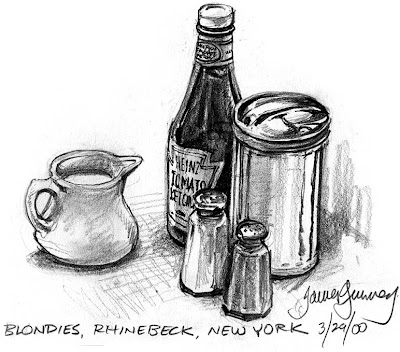
The first drawing interprets the classic diner still life as separate, rational objects bounded by clear outlines. The salt and pepper shakers appear as distinct shapes that could be cut out from the background.
 The second drawing is a bit more subjective. The pepper shaker on the right melts into the background a little more, and tones of shadows blend the bases of the objects into the table surface.
The third drawing, made with a brush and watercolor, interprets the world not as a series of definite objects but rather as spots or shapes that come together to suggest forms. The creamer at the lower left almost disappears into its surroundings; we see only a hint of its handle.
 This is not merely a matter of style or technique. One approach is not better than another. There’s no right or wrong way to see the world and no right or wrong way to draw it. Different people actually see things differently.
In fact, new research in visual perception suggests that the human retina is not like a camera, but more like a kind of a pre-brain. Some groups of retinal receptors bundle visual information into packets describing linear boundaries. Other receptors bundle information about tonal shapes. These packets are then processed downstream in the visual cortex. The retina transmits data at a rate of 10 million bits per second, which is about equivalent to an Ethernet connection. (link)
The way you see is probably not the way I see, regardless of our training or tradition. The way your retina apportions its visual processing tasks is as unique as your fingerprint. You may see things more in terms of line and I may see things more in terms of tone.
The way our eyes apprehend the world is infinitely mysterious. As artists we need to yank ourselves out of our comfortable habits of perception. We need to grow beyond the easy tricks that worked for us in the past. We need to strive always to see with new eyes.
 How you answer these questions lays at the heart of how you approach a drawing.
The first drawing interprets the classic diner still life as separate, rational objects bounded by clear outlines. The salt and pepper shakers appear as distinct shapes that could be cut out from the background.
 The second drawing is a bit more subjective. The pepper shaker on the right melts into the background a little more, and tones of shadows blend the bases of the objects into the table surface.
The third drawing, made with a brush and watercolor, interprets the world not as a series of definite objects but rather as spots or shapes that come together to suggest forms. The creamer at the lower left almost disappears into its surroundings; we see only a hint of its handle.
 This is not merely a matter of style or technique. One approach is not better than another. There’s no right or wrong way to see the world and no right or wrong way to draw it. Different people actually see things differently.
In fact, new research in visual perception suggests that the human retina is not like a camera, but more like a kind of a pre-brain. Some groups of retinal receptors bundle visual information into packets describing linear boundaries. Other receptors bundle information about tonal shapes. These packets are then processed downstream in the visual cortex. The retina transmits data at a rate of 10 million bits per second, which is about equivalent to an Ethernet connection. (link)
The way you see is probably not the way I see, regardless of our training or tradition. The way your retina apportions its visual processing tasks is as unique as your fingerprint. You may see things more in terms of line and I may see things more in terms of tone.
The way our eyes apprehend the world is infinitely mysterious. As artists we need to yank ourselves out of our comfortable habits of perception. We need to grow beyond the easy tricks that worked for us in the past. We need to strive always to see with new eyes.
Đăng ký:
Bài đăng (Atom)