Hiển thị các bài đăng có nhãn Models Posing. Hiển thị tất cả bài đăng

Thứ Tư, 11 tháng 11, 2009

Monster’s Assistant

Arthur Rackham, the story goes, hired an old woman model who posed for many of his characters: not just nymphs and hags, but also trees and dragons.

Whenever you’re creating an imaginary creature, it’s good to have someone act out the pose. In a pinch you can act it out yourself in front of a mirror or a camera with a self-timer. You can change all the forms around, but there are often valuable details you can pick up from real life.


This little hunchback monster, a sidekick to the Birdman character (full image on earlier GJ post) was such a reality-based creature.

Even though I made a little maquette, I based details of his forehead and his hands on the live-action photograph, which I made with a digital camera on a timer.

The original painting is currently on display at the "Son of Baby Tattooville" exhibition at Riverside Art Museum in southern California. The show will end November 21.

Earlier GJ post on the exhibition.

Chủ Nhật, 18 tháng 10, 2009

Rockwell and the Camera

Norman Rockwell went to great lengths to get his models to act. He spared no expense in hiring photographers to document their performances. The resulting photos—20,000 of which are in the Norman Rockwell Museum’s archives and have just been digitized—served as references for most of his famous Post covers after the mid-1930s.


As a new book and an upcoming exhibition demonstrates, Rockwell was always conscious of going well beyond the photo, striving for a exaggerated reality to communicate his ideas.

His painting “The Gossips,” 1948 (Oil on canvas, 33” x 31”) is a good example. The 30 heads in the painting pass along a piece of gossip about Mr. Rockwell himself, who confronts the source of the rumor in the last pairing.
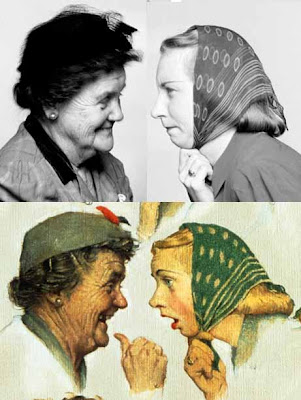
The old lady and the young woman with the scarf went through a big transformation from photo to painting. The older woman in the painting is seen more in profile; and her smile is broadened. The younger woman’s eyes and her mouth open wider and her head tilts more forward.

The man in this pairing gets a bigger shock of hair, a pointier nose, and a more wide-open mouth. His neck protrudes from a greatly simplified collar. The woman is brought more into profile, and she’s given a hand.

The man at left loses his hat, probably to avoid duplicating his counterpart. All his expressive features: eyes, eyebrows, and mouth are exaggerated—and he gets a hand with a cigar. The man at right, who appears just before the crescendo of the story, is pushed to the extreme. His chin tucks in, his hat tips to the side, he’s gets a bow tie, and his head takes the shape of a light bulb.

Rockwell also lifts his eyebrows. Hardly any model—except maybe Jim Carrey--can simultaneously drop the jaw, squint the eyes, and lift the eyebrows. It’s not easy; try it! But it looks right, and Rockwell got it in the final.

Rockwell always wrestled with his conscience over his use of the camera and the projector, which he called “an evil, inartistic, habit-forming, lazy, and vicious machine.”

But he should have been easier on himself, because he really set a good example to the rest of us about how to use photos intelligently. He rarely forgot his initial conception, and he only used the photos as a starting point.

As he said in his classic work “Rockwell on Rockwell,” 1949, “I feel that the characters which I produce in this way more nearly express those which I have in my mind and which I am trying to portray.”
------
More about new book Norman Rockwell Behind the Camera, by Ron Schick on Amazon.

The exhibition: Norman Rockwell Behind the Camera will run at the Norman Rockwell Museum from November 7 – May 31, 2010, link for more info.

There’s an article in this month’s Vanity Fair with lots of images and a surprisingly respectful biographical overview.

Thứ Tư, 2 tháng 9, 2009

Cumberland, Part 3: Acting It Out

My next job was to die a thousand deaths.

I had to act out the parts of all the sailors in various conditions of
leaping, swimming, nursing injuries, or manning oars. Wearing a navy uniform that I found in a surplus store, I jumped off a platform and writhed around on the ground, trying to imagine what it would have been like for the various sailors who were coping with the tragedy.

My wife took snapshots with a digital camera. One of the photos has a motion blur effect that I used in the final painting. There were something like 90 figures in all, and I wanted to make each one a little actor facing his own terrible drama.

One of the most helpful parts of the research was a visit with a naval historian named Colan Ratliff at the Naval Surface Warfare Center in Bethesda, Maryland. This was an awesome place to visit, but I couldn't take pictures because it's a classified research facility.

Mr. Ratliff, who works deep in the heart of the complex, has built several museum models and drawn extensive plans of the vessels involved in this battle.

From our consultations, and from the approved concept sketch, I made a comprehensive line drawing and sent copies to Mr. Ratliff. His notes, drawn on a sticky note over the photocopied drawing, corrected some of my errors.

I had shown the old-fashioned deadeyes instead of rigging screws and had drawn the wrong kind of gooseneck attaching the boom to the mast. These corrections were going on by phone, mail and email for months after our meeting.

It really helps when a scientific or historical consultant can draw to explain their points, and many of them can.

With all the references and corrections in place, and after nearly a year of
research and roughs, I finally was ready to start the 30 x 40-inch oil painting, which took a couple of months. Most of the time was devoted to painting the various figures.

As I worked, I did everything I could to project myself into the action of the scene: playing the soundtrack to Master and Commander, the Flying Dutchman overture, and Rimsky Korsakov——and reading again and again the eyewitness accounts.

Warfare was such a brutal face-to-face thing in the Civil War. The guys on the Virginia could hear the screams of the Cumberland's wounded men below decks as they drowned.
-----

Sinking of the Cumberland, Part 1A: The Backstory
Sinking of the Cumberland, Part 1B: The Research
Sinking of the Cumberland, Part 2: Choosing the Scene
Sinking of the Cumberland, Part 3: Acting it Out
Sinking of the Cumberland, Part 4: Final Art

Thứ Ba, 23 tháng 6, 2009

Costumes, Part 2

Continuing yesterday's costume tips:


7. You can improvise a lot of costume details with samples of fabric combined with old clothes from your closet. It doesn’t matter if the color matches or if it looks good enough to go on stage. You’re just looking for information about folds and drapery.

8. If you can’t fine the right costume, don’t worry! Remnants of leather, satin, brocade, or velvet from a fabric store can provide you with helpful information about the behavior of the fabric. Steel bowls from the kitchen can give ideas for how armor would look.

9. For simple togas and capes, you can drape and pin fabric samples over your artist mannikin or dressmaker’s dummy. For the fabric to scale down to a miniature size, it should be a very light weight. Cellophane scales down really well over a miniature figure, and can be spray painted to give it opacity (Thanks, Graydon).

10. Don’t be shy to ask for help. If you know someone who is clever with a sewing machine and can think laterally, they might be able to help you improvise a few basic things.

11. Once you get your model (or yourself) in costume, you can take reference photos in a variety of poses. If it’s an easy pose to hold, you can work directly from the model. That's how I did the painting of Oriana above, which appears in Dinotopia: The World Beneath. I put pieces of tape on the floor to mark where the model's feet should return between breaks. The whole session only took about an hour and a half, which saved time over shooting reference or doing drawn studies.

12. If you attend a sketch group, ask if your fellow artists might enjoy sketching from a costumed model. If so, everyone can pitch in a costume or two, or the models may come with something. You can usually pay the model to stay after the sketch session to work with you for reference.

Thứ Hai, 22 tháng 6, 2009

Costumes, Part 1

An artist like Edwin Austin Abbey (below: "Who is Sylvia") was legendary among his peers for lavishing a fortune on the right costume for reference. (More Abbey samples here)

Good costumes can be expensive to buy or rent. And they can be difficult to make. But having a real costume makes a huge difference in your finished work. You can tell right away if an artist just made up a costume or went to the trouble to get a real one.

Abbey’s illustrations commanded princely sums a hundred years ago. What are we mortals to do nowadays on a shoestring budget? Today and tomorrow I'll offer 12 tips to save you money, time, and trouble.


1. You can find costumes at thrift stores or junk shops. Almost every garage sale has a Halloween costume or an unusual hat that you may want to use later.

2. Many smaller communites have a local theater company with costume collections. They are sometimes willing to loan their costumes to illustrators.

3. Renaissance festivals have vendors with an assortment of hats, cloaks, corsets, gowns, breeches, and doublets. Example: Moresca Clothing and Costume. That’s where the blue and red jacket came from, and I’ve used it in many Dinotopia pictures.

4. People who work in living history museums wear very authentic costumes. I've found they're glad to model for a sketchbook study. They may also be willing to pose for photo reference, but be sure to get their written permission first. Examples: Plimouth Plantation, Old Sturbridge Village, Colonial Williamsburg.

5. Big cities like New York, London, or Los Angeles have rental agencies serving theatrical or movie productions. Sometimes they will sell off their older, worn-out costumes. That’s where the doublet with the slashed sleeves above came from. Examples: Palace Costumes, Adele's Costumes.

6. Large museums, like the Metropolitan Museum or the Victoria and Albert in London have costume collections which can usually be sketched or photographed. Examples: Metropolitan Museum Costume Institute, Victoria and Albert Museum, London.

Tomorrow: Six more costume tips.

Thứ Sáu, 8 tháng 5, 2009

Fantasy Art in High School

Kathleen Harte, visual arts instructor at Millburn High School in New Jersey, has encouraged her students to use maquettes and posed models to add realism to their imaginative work.


According to Ms. Harte:
“One of the students, Joy Jeong, had to create an image of a young girl riding a giant caterpillar for a series of 12 paintings she is creating based on a story she originated in which giant insects have invaded our world.

Joy had seen your book, Dinotopia, and had heard me tell about the presentation you gave at the Society of Illustrators last year. I had explained how you make models when needed to use as reference and to explore lighting situations. So Joy came in after school and made a rough mock up of her caterpillar. She put a small figure on it that I brought in from my own studio and used a strong light to create her shadows. Combining those photos with one she took of a fellow student, she created the final piece that I have included here.”


Thank you to Ms. Harte, Joy, and Anna, for permission to use your images. I’m impressed with the wonderful results you got from your extra effort. It’s fun to imagine what will happen next in your story world when that caterpillar turns into a butterfly.

For other arts instructors in the Mid-Atlantic region, don’t miss the Dinotopia arts-in-education event tomorrow in eastern Pennsylvania. Here’s the official announcement, and I hope to meet many of you there.

James Gurney, author/illustrator of ''Dinotopia,'' will talk about his fantasy artwork and sign copies of his books about a world where humans and dinosaurs live together in harmony. It's Saturday at Zion's Reformed United Church, 622 Hamilton St., Allentown. Gurney's talk is part of the Lehigh Valley Arts Council's arts-in-education forum. He will talk at 1 p.m., followed by the book signing at 2 p.m. Tickets are $10; $5, students. Info: 610-437-5915, http://www.lvartscouncil.org .

Thứ Bảy, 2 tháng 5, 2009

Backyard Posing Party

Creating Dinotopia paintings has often led to strange parties in my backyard.

In the spring of 1991, I invited a whole bunch of friends to pose for a painting of a dinosaur Olympic event called Ring Riders. The painting appeared in Dinotopia: A Land Apart from Time,

Each kid chose which hat or headdress they wanted to wear. I played both actor and director while my wife Jeanette worked the camera.

One mom made a bunch of pastries and handed them out. I used that moment in the final painting.

Using chairs and cushions and cardboard rings as props, the kids took their positions, imagining they were riding on the backs of the dinosaurs. It helped when it I acted it out first, hamming it up a little to try to get them to loosen up.


A group with mismatched costumes and with varying levels of enthusiasm acted out the part of the crowd watching the sporting event. I’m sure they could sympathize with modern actors who have to emote in front of a greenscreen.

This form of group acting works especially well with young people. Chance moments and improvisations can take your conception to another level.
------
Related post on using photo reference, link.
Thanks, Nancy, Jake, Aliza, Judy, James, Mike, Joey, Morgan, Justin, Franklin, Jeanette, and everyone else who took part!

Thứ Sáu, 10 tháng 4, 2009

Lovell's Soldier

When American illustrator Tom Lovell (1909-1997) painted the standing soldier for The Continental Insurance Company, he researched the weapons and costume at a museum and did a charcoal study from a nude figure to understand the pose. The studies appear surrounding the finished illustration in this page from an article in North Light Magazine.

Here's how Lovell himself described the process:
The requirement here was to create an heroic, slightly larger than life embodiment of a man who could be identified with dependability and authenticity and at the same time be real. This was done to replace the original trademark figure used for many years by the Continental Insurance Company.

Before consulting a model, I drew this basically strong figure, to be certain he would not be overpowered by his equipment. Research in depth was done at West Point Museum under the guidance of Col. Frederck P. Todd, then curator. The painting later won a gold medal at the Society of Illustrators Annual National Show.

---------
Image is trademark of the Continental Life Insurance Companies.

Leif Peng's excellent illustration art blog "Today's Inspiration" has been doing a feature this week on Lovell , drawing from the 1956 American Artist profile by Norman Kent.

The material in this post was drawn an article "Tom, The Unswervable Lovell," in the North Light Collection, Volume 2, 1979, a compilation from the North Light Magazine.

Lines and Colors tribute to Lovell, link.

Chủ Nhật, 1 tháng 3, 2009

Model to Mermaid

How do you get a mermaid to pose? Like unicorns and dragons, they are fantastical creatures, not entirely of this world. I wanted my mermaid painting to look real but not in a literal or material sense.

Although in previous posts (here, here, and here and here) I’ve suggested using photography for figure reference, when it comes to mythological or storybook beings I prefer to use life studies rather than photos because I feel freer to be guided by my imagination.


I did two studies, one in charcoal and one in paint, both directly from the model. In the charcoal study I concentrated on the basic linear gestures and on the soft lighting of the form. I also started thinking how to join the human form with a fishlike tail and how to bend the tail so that she could ride “sidesaddle” on a tamed sea creature.

I recalled from my experience snorkeling that skin tones appear cooler in water than they do in the air, and the side planes of the figure fall away to a bluish hue, lit from all directions by scattered light in the water. The color study above, made with the model in front of a blue cloth, allowed me to start exploring this unusual and magical color quality.

In both studies I took the first step toward my mental image, making changes in what I was seeing and not copying the model literally.

Thứ Tư, 18 tháng 2, 2009

Kushite King

In an earlier post I mentioned that a good way to develop reference for figure work is to pose yourself in front of a mirror and make a charcoal study on tone paper.


For this National Geographic illustration I needed to show a triumphant Kushite king accepting the homage of vanquished princes in Egypt in 724 BCE.

I first met with the project archaeologist Dr. Timothy Kendall in the basement of the Museum of Fine Arts in Boston. He showed me primary-source drawings of the snake headdress, sandals, wing corselet, and transparent garment worn by Kushite royalty.

I wrapped myself in a sheer curtain to simulate the costume. I set up the tone paper on an easel and acted out the pose, looking at the reflection in a full-length mirror mounted on a door.

Even though I’m not exactly the right type for the character I was portraying, I was only looking for the basic structure of the pose. I could get the Nubian features from other sources.

I recommend the method for three reasons. It’s often faster than shooting photo reference. It gets you immediately away from the photographic look. And it forces you to begin interpreting the pose, making artistic decisions that give your result more coherence and impact.

Mirror studies have always been a favorite method for animators acting out facial expressions and gestures. For faces, you can use a medium sized mirror hung in front of your work table.
------------
For a previous GJ post on installing a full-length mirror, link.

Here's a selected list of articles I've illustrated for National Geographic:

March 2006 Battle of Hampton Roads
Dec. 1997 Patagonian Dinosaurs
Nov. 1990 Kingdom of Kush
Feb. 1989 Attic Scene
Oct. 1988 Moche, Peru
May 1988 Wool
June 1988 Etruscans
July 1987 Soybeans
June 1987 Eskimos
Aug. 1986 Ulysses
Sept. 1985 Jason
Sept. 1985 Humboldt

Thứ Hai, 27 tháng 10, 2008

The Mirror Trick for Kid Portraits

The hard part about painting a kid from life is getting him to hold still for more than ten minutes. Here’s a trick. Set up a full-length mirror behind you so that your subject can watch you work. They will be captivated for at least two hours if you’re lucky. That’s how I painted this picture of my son Franklin when he was seven years old.

Thứ Tư, 24 tháng 9, 2008

Action Poses and Photography

For much of the nineteenth century, the mental image of the galloping horse was this pose, typified by this Currier and Ives print from 1890.

As blog reader R8R mentioned this in yesterday’s comments, Eadweard Muybridge began systematically photographing running horses as early as 1877.


This began as a way to settle a bet about whether a horse really had all four feet off the ground at a single time. The photos proved that it does, but not quite in the way artists had imagined. At the moment when all four feet are off the ground, they’re gathered under the horse’s belly, not kicked out front and back.

According to the photographic evidence, the Currier and Ives picture was inaccurate, even though it was done after Muybridge’s photos were available.

Muybridge’s evidence must have been hard for artists to digest at first. Modern painters like Marcel Duchamp, to their credit, were grappling with how to capture the dynamics of action in a single painting. There’s no easy or right way to do it, despite my promise at the end of yesterday’s post.

Yesterday we looked at three paintings of people walking. All of these paintings were based on poses that a model could hold in a static position. Although Wyeth and Rockwell certainly had access to fast-action photos of people in motion I suspect that candid action photographs didn’t “look right” to them.

A lot of you commented in praise of yesterday’s paintings, and I agree. Cormon’s image has gravitas; Rockwell’s has a stateliness, and Wyeth’s a desperate urgency. But I think they’re successful despite their posing of action. Not only are the poses all the same in each picture, they're not consistent with the realism of the rest of the treatment, and I think a painting that shows an action has to be convincing not only as a singular, static image, but also as a moment in a larger conception of movement and time.

Since Muybridge, the notion of what “looks right” has changed somewhat. Most of us wouldn’t accept the standard Currier and Ives pose for running horses anymore. We accept photographic action effects, like the blurring of a moving foot, for example.

Most illustrations by the mid twentieth century that show action poses—like this advertising illustration by Austin Briggs—tended to rely on candid action photography for paintings of action scenes. As a work of art, this one is a bit silly, but clearly he did his homework and really posed models in the action.

Tom Lovell also clearly studied action photography for this painting of Alexander for National Geographic. To my eye, this painting is successful in terms of movement because it conveys both the timeless epic and the snapshot incident.

Thanks to Leif Peng for the Austin Briggs image, link.
Muybridge on Wikipedia: Main article, and assorted animated gifs.

Thứ Năm, 18 tháng 9, 2008

Slowing Down

Back in 1994, my friend Garin Baker invited me to join him for a figure painting session at the School of Visual Arts in New York. He was working from the model with a group of master figure painters that included Max Ginsburg and Steve Assael.

As I recall, they had already been painting from the same model for some weeks. This was their fourth or fifth session with the same pose. By the time I joined them, they had put in 20 or 30 hours into that one pose.

I was amazed with the quality of their work, which showed deep observation. I was so accustomed to painting from the standard 20- or 30-minute poses in most sketch groups, that even a three-hour session seemed like a huge luxury.

After two hours on the same pose, I felt like I overcooked the pasta.

So I applied the Ninety Degree Rule. Steve Assael became my subject. I felt energized. Here was a living, moving subject and only 45 minutes of time left. Even though he wasn’t holding completely still, there was a quality of life and tension that excited me.

I greatly admire what my colleagues have accomplished with extended observational poses, but I guess I’m more suited to catching life on the run.

I’m curious to learn from those of you who have more experience than I do painting from long poses. How much time is ideal for you? How do you pace yourself with longer poses? If you were running an atelier, how would you balance short and long poses?
--------
Related GJ post "Artists as Models," link.
"Ninety Degree Rule," link.
Websites for Steve Assael, Max Ginsburg, and Garin Baker.
Max Ginsburg has an exhibit "Visions of Reality," in NYC through Sept. 26.
Also, Garin, Steve, and Max are part of a group show called "The Old Hat Club" at the High School of Art and Design, through October 3.