Hiển thị các bài đăng có nhãn Dinosaurs. Hiển thị tất cả bài đăng

Thứ Năm, 29 tháng 10, 2009

Prehistoric Times


If you're interested in dinosaurs (and other extinct creatures) you'll love the magazine Prehistoric Times, which for over a decade has covered the intersection between science, art, film, and collecting. Now published in full color, it presents interviews with artists and paleontologists, dino drawing tips, book reviews, and round-ups of recent discoveries. It's also a good venue for emerging paleoartists to showcase their work.

-----
Prehistoric Times website.

Thứ Hai, 5 tháng 10, 2009

Mei Long, Part 2

Let's finish yesterday's post about reconstructing the feathered dinosaur Mei long. For a pose as unusual as this, I knew I had to build a maquette to understand the three dimensional spiraling and overlapping of the form. Where should that tucked leg go? And what should happen with the tail? At this angle, you can't see the tucked leg, but it's there.

The maquette was made over a wire armature from three kinds of Fimo: soft, regular, and effect. The last kind fires to a translucent and flexible material. I then painted it in acrylic.

As I built and painted the maquette, I checked a lot of reference photos from my physical and digital scrap files. I came up with dozens of pictures of birds (aquatic birds, songbirds, and many others) in this classic pose. Photos of actual backlit birds helped with edge lighting and color corona.

Here's the final oil painting, which appears in the current issue of Ranger Rick magazine.

Chủ Nhật, 4 tháng 10, 2009

Mei Long and Sleeping Dinosaurs

The fossil of the small flightless dinosaur Mei long shows the tail wrapped around the body, with the head tucked back under the front arm. The name Mei long means "dragon, soundly sleeping."

Mick Ellison did this reconstruction of the sleeping pose. When Ranger Rick asked me to paint Mei long for the new October issue (which should be on the stands now), I didn't want to copy my friend Mick's beautiful visualization.

I tried to find out all I could about how contemporary birds sleep. Mike Della Chiesa, who runs a bird breeding center in Saugerties, New York, told me that almost all songbirds and parrots sleep standing on one foot. If they don't, it can be a sign that they're not healthy or happy.

I also spoke with Manny Carrasco, who works a lot with modern raptors, such as hawks, falcons, and eagles. He said all the birds he works with also like to sleep on one foot. I had never seen a painting of a small dinosaur resting on one foot, but it made intuitive sense to me.

So I did this sketch to show the art director. Tomorrow I'll show you how I went from this to the final oil painting.
-----
"How I Paint Extinct Animals" on the Ranger Rick website.
Wikipedia on Mei long.

Thứ Sáu, 11 tháng 9, 2009

Gryposaurus, Part 2

With the maquette described in yesterday's post, I went outside and set it up on a piece of filmmaker's grip equipment called a C-stand. Now I could experiment both with different angles and different light directions and see exactly what was happening with the shadows.


I found some very tiny leaves and put them in the dinosaur's mouth. I wanted to see real leaves to study the transmitted light. I also went to a botanical garden to photograph magnolia leaves, and used those leaf shapes for reference.

Here's the final painting in oil on illustration board. I concentrated detail and dark accents around the eye and the tongue, which in the maquette is curling back to grab the leaves.
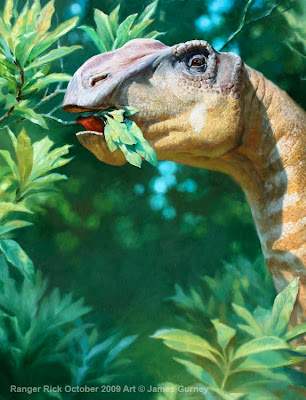
The far forest goes way out of focus to subconsciously suggest that this is a wildlife photo. Technically I handled this with white nylon flat brushes after a bristle block-in.

Shallow depth of field is common in wildlife photographs because they are usually shot with telephoto lenses, which have a very narrow focal plane.

I also used an effect called "bokeh," which I haven't really defined yet on the blog. Bokeh (Wikipedia explanation here) is that cool photographic effect where far away bright highlights or sky holes become circles that increase in size with distance.

Even though I'm a traditional painter, I'm using a lot of photographic effects here quite deliberately to create a photographic impression and to blend the images naturally in Ranger Rick. Although I used those effects, I didn't trace the reference photos because there were a million ways I wanted to improve on them.

A lot of what I've learned about light and color and vision has come from my conversations with professional photographers, who think about imagemaking a little differently than artists usually do. Hope all this stuff isn't too dry and technical.
------
I'll be heading into New York City today for the Spectrum opening and Art Out Loud, so probably won't post tomorrow.

Thứ Năm, 10 tháng 9, 2009

Gryposaurus, Part 1

Today we continue the behind the scenes look at the new paintings for the October issue of Ranger Rick magazine.

The next creature I needed to visualize was a duck-billed dinosaur called a Gryposaurus (and I misspelled the name). As you can see from my colored pencil sketch, I wasn't too sure what the forms would look like. Even though I was looking at lots of fossils, he looks lumpy and unconvincing. If I went ahead on the final painting, it would only have looked about 10% better.

I think you really learn a form through your fingers (that's why I love museums that have casts of great sculptures that you can run your hands over). By making a tiny sculpture of this particular dinosaur, using Fimo over tin foil and armature wire, I came to know my subject.

I kept checking it against the drawing. That nasal bone is not quite high enough.

I painted it with acrylic, darkening around the eyes. Many animals have dark color around their eyes for the same reason that football players smudge stuff around their eyes: to cut down on glare.

Tomorrow I'll show you how I photographed the maquette and proceeded with the painting.

Chủ Nhật, 30 tháng 8, 2009

Jurassic Park Set Visit

In 1992, when I was in the middle of a booksigning in LA, a guy said came up to me and said, “Hey, if you’re not doing anything tonight, do you want to check out the set for Jurassic Park?”


His name, it turns out, was Mike Trcic, one of the hottest creature sculptors in the business. He worked at Stan Winston Studio and helped develop the look of the animatronic T.rex that attacks the car in the rainy night sequence.

When we arrived on set, the night crew was wielding blow driers on the inert dinosaur, trying to dry out the heavy water that the foam rubber skin had absorbed from the rain machines.

The T.rexes didn’t have legs. The bodies rested on sophisticated (and potentially dangerous) motion bases that could quickly move the upper body around. The feet were built as separate pieces used for close-ups. The digital effects get a lot of credit in Jurassic Park, but the animatronics were equally groundbreaking.

Some of the artists told me that they anticipated that much of the work they were doing would be superceded by CGI. As it turns out, animatronics have held their place in the industry, a necessity for close-ups and interactive shots.
----
Thanks, Mike! More about Trcic Studio.
Wiki on Stan Winston.
"How Stuff Works" about the Jurassic Park animatronics, link.
GJ post on interactivity.

Thứ Tư, 12 tháng 8, 2009

Caption Contest

This drawing from 1989 is an early experimental (and failed) attempt to work out the technique for Dinotopia.

But it needs a humorous caption. So I'm inviting you to contribute one in the comments below. Either the dinosaur or the kid could be talking.

The deadline is tomorrow, Thursday at 9:00 p.m., Eastern time. I'll pick three finalists, each of whom will receive as a gift a signed, two-sided poster for Imaginative Realism (the book itself will be published in early October).

On Friday you'll be able to vote on your favorite of the three caption finalists. The grand prize winner will receive an additional Dinotopia poster and a hand-drawn remarque.

Thứ Bảy, 30 tháng 5, 2009

Spiderwick Meets Dinotopia

Tony Diterlizzi asked a bunch of his art friends to do drawings set in the Spiderwick cosmos. The drawings will appear in the back of an upcoming omnibus edition of Spiderwick stories.

I drew Hogsqueal riding Bix.


Here’s a movie of the work in progress, drawn with a Niji water brush filled with Higgins Eternal ink.


I gave the original to Tony and he reciprocated with this nifty drawing of Will Denison meeting a befeathered Bix. I love it!

Read how he developed his drawing on his blog, link.

Thứ Tư, 18 tháng 3, 2009

Drawing from Maquettes

Andy Wales, a frequent commentator on this blog and a contributor to Art By Committee, is also an elementary school art teacher at the Lynch Bustin Elementary School in Athens, Pennsylvania.

In anticipation of my visit next month, he has been using maquettes with his young art students so that they can make their fantasy drawings more realistic.

"We're not building our own models, but we are using dinosaur toys and action figures to imagine scenes. Above you see that Cyclops of the X-Men is taped to a dinosaur. We're working with the lights off, using only the lights that come in from the skylights. In my demonstration sketch, I'm showing the kids how to use charcoal, blending stump and erasers to create shadows and highlights on objects."


Andrew Wales’ blog Panel Discussion, link.
The Lynch Bustin Art Room, link.

Thứ Sáu, 20 tháng 2, 2009

Poultrysaurus


Who needs Jurassic Park? According to Jack Horner, we can make a dinosaur—or something like a dinosaur—by retro-engineering the DNA in a chicken. The blueprint is already sitting there; it’s just a matter of controlling gene expression. Jack’s book “How to Build a Dinosaur” comes out next month.

How Stuff Works video, link.

Thứ Sáu, 21 tháng 11, 2008

Storyboard


This little storyboard sketch from Dinotopia: Journey to Chandara is one of many that didn’t make the cut, mainly because the idea evolved from this point. At this point I thought of having a Therizinosaurus ridden by a Chandaran border guard. As I thought about the character, I thought it would be far more interesting to have a more sympathetic character connected with the dinosaur, and the idea for the retired conductor Cornelius Mazurka developed.